

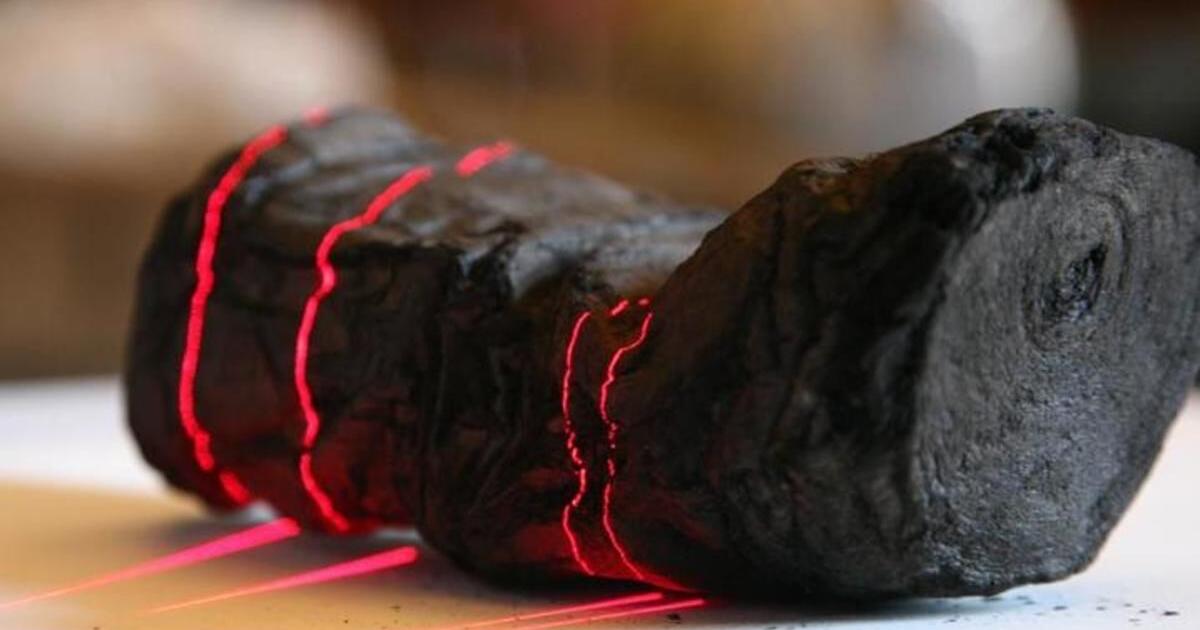
AI has allowed experts to read ancient Roman scrolls that were covered in volcanic ash from an eruption from Mount Vesuvius 2,000 years ago.
Luke Farritor is one of those guys who thinks about the Roman Empire a lot.
The University of Nebraska-Lincoln student isn’t spending his time contemplating how the Romans built an extensive network of roads, or why the calendar set by the Romans is still widely used to this day.
Rather, the computer science major often finds himself pondering how to hone the use of artificial intelligence and machine learning to read papyrus scrolls buried under volcanic ash and mud from Mount Vesuvius nearly two millennia ago.
Luke Farritor
In August, the 21-year-old was announced as the winner of a global contest to uncover the secrets once thought lost to time when his algorithm detected several letters on the scrolls, which led researchers to translating them into a word.
“I’ve been into programming for as long as I can remember,” Farritor told the Journal Star. “And I’ve also always been into history. I knew combining those two things into one could be really helpful.”
People are also reading…
Farritor, a Lincoln native, said he learned about the Vesuvius Challenge during an internship with SpaceX in Texas that ran between March and July this year.
Listening to Nat Friedman, a former Microsoft executive who runs and invests in technology companies, describe the Vesuvius Challenge on a podcast, Farritor said he became consumed with joining in and trying to solve the mystery.
The Herculaneum scrolls, charred and buried in a library near Pompeii during the eruption in 79 A.D., were uncovered in the 1750s but have remained unopened due to their brittle nature.
Two decades ago, Brent Seales, a computer science professor at the University of Kentucky, and a team of researchers developed a process that allowed them to scan the scrolls with X-rays layer-by-layer.
But because the ink used by whoever had written the scrolls — historians have postulated they belonged to a relative of Julius Caesar — was charcoal and water, the messages they contained remained nearly invisible.

A Herculaneum scroll, charred and buried in a library near Pompeii, is scanned with red laser lines at Institut de France by Brent Seales, a computer science professor at the University of Kentucky.
Seales eventually developed a program that could detect the presence of ink on the charred documents, and with funding from science and arts organizations and with backing from Silicon Valley sought help from the broader public in developing a method for reading them.
Farritor, the son of UNL mechanical engineering professor, inventor and start-up founder Shane Farritor, was one of about 1,500 people who answered the call after hearing Friedman describe the problem and offer the prize money.
“(Friedman) said ‘if you’re listening right now, you might win the challenge,'” Farritor said. “I was like ‘holy cow, I have to give this a go.’ This project just had a lot of potential.”
Farritor said he worked the problem on nights and weekends for most of the summer, looking at attempts taken by others working to solve the problem and iterating on his own code little by little.
There were two big breakthroughs that came after Farritor joined the Vesuvius Challenge.
The first came when another contestant, Casey Handmer, an entrepreneur from California, found a pattern that corresponded to what he believed was writing on the papyrus parchment.

The Greek characters, πορφύραc, revealed as the word “purple,” are among the multiple characters and lines of text that have been extracted by Vesuvius Challenge winner Luke Farritor.
Farritor and others begin focusing their algorithms to look for other patterns on the scrolls, comparing his own results with potential solutions put forward by other contestants, and looking at the original scans.
The second breakthrough happened at an Omaha house party for a friend’s birthday in August.
Farritor said he received a text notifying him of a new scan, and using his phone, logged into his computer remotely, uploaded the photo, and set his algorithm to work.
Hours later, when he parked his car in the garage of his Lincoln apartment, Farritor checked the progress on his phone and saw three Greek letters — two O’s and a P — staring back at him on his phone screen.
Farritor broke out in a one-person riot, celebrating the monumental discovery, as his friends stood by confused: “I was jumping around, yelling and screaming.”
“There was kind of this moment late at night after that party where I realized ‘oh my goodness, we’re probably going to read the scrolls,'” he added.
He quickly sent a text to his mom and to the organizers of the Vesuvius Challenge to confirm his findings, and over the next week, refined his AI program to uncover about 10 more letters on the scroll.
Researchers later combined the Greek letters into the word “porphyras,” which translates into an ancient Greek word for “purple.”
The monumental discovery made Farritor the winner of the First Letters Prize, which came with $40,000 cash, and gave him celebrity status among papyrologists and entrepreneurs. Mark Cuban, the billionaire investor, sent Farritor a message of congratulations, as did Tyler Cowen, an economist, professor and podcaster, he said.
Farritor’s social media following also increased tenfold quickly after news broke of his discovery, he said, and put him on a whirlwind tour that took him to the University of Kentucky, Los Angeles and San Francisco.
“It was all really cool,” he said.
The UNL senior said he’s not stopping at the First Letters Prize. The Vesuvius Challenge is offering $700,000 to the first person who can read four paragraphs inside the scroll, something Farritor said he’s optimistic he can make happen by the Dec. 31 deadline.
From there, Farritor said it could theoretically be possible for researchers to delve into the hundreds of scrolls that have been recovered from Pompeii but never opened.
“The possibilities are really exciting,” he said.
Top Journal Star photos for October 2023

(from left) Aksel Bartles, 5, his sister Rexa, 2, and mother Missy trick or treat during the Boo at the Zoo at the Lincoln Children’s Zoo, on Thursday, Oct. 26, 2023.

Lincoln Pius X players react after Keeleigh Knobbe (7) scores match point of the A-7 district championship against Papillion-La Vista on Wednesday, Oct. 25, 2023, at Pius X High School.

Sara Madsen and her husband, Brady Clark, shoot pool at Madsen’s Bowling & Billiards on Wednesday. Sara Madsen has taken over management Madsen’s Bowling & Billiards from her cousin Benjamin Madsen.

St. Teresa Catholic School second-grade student Nicholas Bauman makes a field goal attempt from the hold of University of Nebraska-Lincoln sophomore Tyler Aldredge during Memorial Stadium birthday party on Monday. The stadium celebrates its 100th anniversary this season.

Nebraska’s Laney Choboy makes a diving save in the fifth set at the Devaney Sports Center, on Saturday, Oct. 21, 2023, in Lincoln.

Nebraska players celebrate the victory against Wisconsin on Saturday at the Devaney Sports Center. Laney Choboy (right) went to the ground and slapped the floor.

Northwestern’s Garnett Hollis, Jr. successfully defends a throw intended for Nebraska’s Jaidyn Doss in the third quarter at Memorial Stadium, on Saturday, Oct. 21, 2023.

Northwestern’s Devin Turner (9) intercepts a pass intended for Nebraska’s Thomas Fidone (24) on Saturday, Oct. 21, 2023 during a match at Memorial Stadium in Lincoln. Nebraska was up 10-6 going into the half.

Halyna Chekushkina (from Ukraine) serves traditional Ukrainian food to guests during an appreciation dinner on Friday hosted by House of Prayer in Lincoln. Chekushkina, a member at House of Prayer, immigrated to Lincoln from Ukraine three years ago.

Lincoln Southeast’s band members return to the bleachers before a high school football game against South Sioux City, Friday, Oct. 20, 2023, at Union Bank Stadium.

Lincoln East players stand for the pledge of allegiance before taking on Gretna at Seacrest Field, on Friday, Oct. 20, 2023, in Lincoln.

Jaye-Lynne Meyer of Plattsmouth browses a selection of native plants on Friday during a plant sale at the Nebraska Statewide Arboretum (NSA) Greenhouse on the UNL East Campus. All proceeds from sales go toward funding statewide arboretum programs.

Lincoln East’s Mallorie Meyer (right) celebrates after a kill by her teammates in the second set during the HAC tournament championship match at Lincoln Southeast High School, on Thursday, Oct. 19, 2023.

Traffic flows steadily east along K street as the sun sets behind the Nebraska State Capitol on Wednesday, Oct. 18, 2023, in Lincoln.

Norris’ Alivia Hausmann reaches out as she attempts to save the ball in the third set at Lincoln Lutheran High School, on Tuesday, Oct. 17, 2023.

Hastings’ Moritz Kaufmann falls to his knees as he celebrates winning the Class B No. 2 singles title Tuesday at Woods Tennis Center.

Lincoln Christian’s Andrew Penrod celebrates after he and partner Benjamin Mooss won the Class B No. 2 doubles state title Tuesday at Woods Tennis Center.

Nebraska players stand ready as the starting lineup is announced before taking on Penn State at the Devaney Sports Center, on Saturday, Oct. 14, 2023, in Lincoln.

Nebraska’s Laney Choboy celebrates after a point in the second set at the Devaney Sports Center, on Saturday, Oct. 14, 2023, in Lincoln.

Lincoln East’s Hunter Nelson returns the ball in the No. 1 singles championship match at the Class A state tennis tournament, Saturday, Oct. 14, 2023, at the Woods Tennis Center.

Nebraska’s Bekka Allick hits the ball as Michigan State’s Julia Bishop attempts to block it in the third set on Friday at the Devaney Sports Center.

Nebraska’s Lexi Rodriguez dives for the ball against Michigan State in the first set on Friday at the Devaney Sports Center.