
The 100 Most Influential Sequences in Animation Historical past
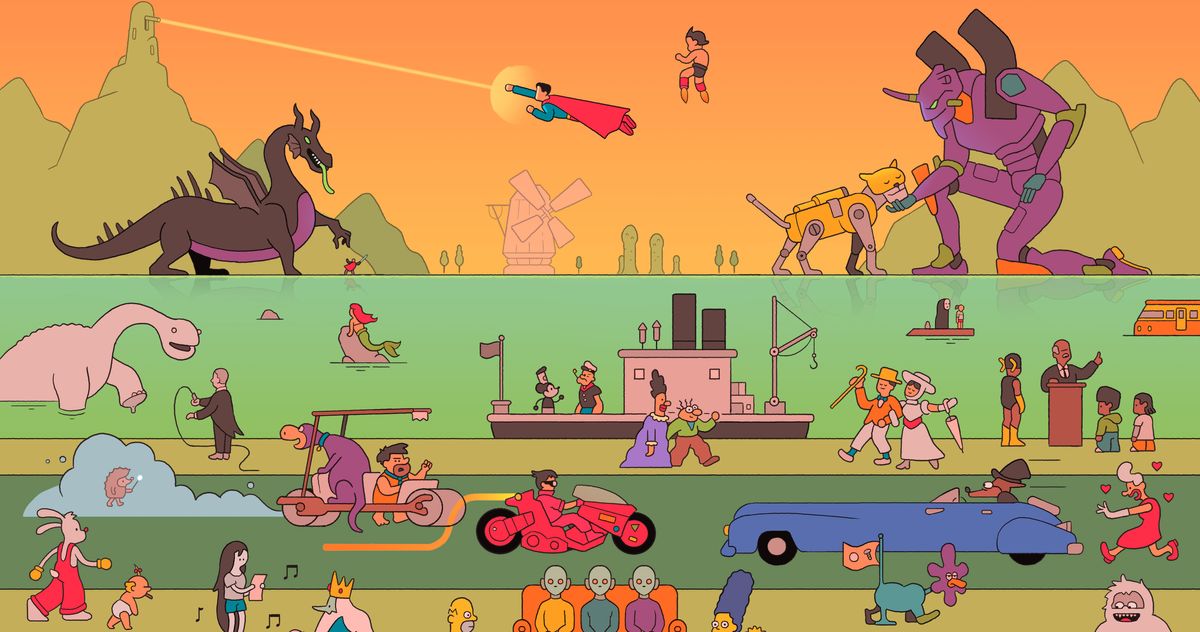
Illustration: Giacomo Gambineri
This article was featured in One Great Story, New York’s reading recommendation newsletter. Sign up here to get it nightly.
All animation, whether it depicts a whistling mouse, a walking dinosaur, or a leaping superhero, is a kind of magic trick. It’s right there in the name of one of the earliest devices used to project slides: the magic lantern. If you take an image of an open hand and an image of a fist and project the two in sequence, you’ll convey the illusion of a clench. “What happens between each frame is more important than what happens on each frame,” the prominent experimental animator Norman McLaren (who makes the list with his short Neighbours, below) once explained. “Therefore, animation is the art of manipulating the invisible interstices between frames.”
That has largely remained true throughout the medium’s history, both frame by frame and over the course of a two-hour children’s movie. Animated cartoons fool the brain into believing that static images can move; characters are “brought to life” by putting pen to paper or finger to a computer’s trackpad. The medium that began to crawl thanks to the live performances of inventor Charles-Émile Reynaud and illusionist Georges Méliès has now matured into a complex and diverse art form — one that has seen new processes and cultural innovations in every decade since its inception. The characters and intellectual properties it has drawn into existence are as relatable as Daffy Duck and as lucrative as Mickey Mouse. Today, vast audiences understand what artists like McLaren were observing: that the invisible holds a marvelous power over us.
To capture an idea of that power and to narrate its history, we have charted the evolution of animation by considering 100 sequences throughout the medium’s history. We chose the deliberately flexible element of a “sequence” because it felt the most focused: It is often in one inspired moment, more so than a single frame or entire work, that we are able to see the form progress. Focusing on full cartoons would create a bias in the favor of studios with the resources to produce theatrical features — but history has shown that many landmark achievements in animation have been produced with a variety of budgets, formats, and lengths. By focusing on sequences, we can let creators and their individual decisions shine in a way full-length works may not.
The arc of this history begins in 1892, the year Charles-Émile Reynaud first used his Théâtre Optique system to screen his moving pictures — to our mind, the first animated cartoons ever produced — for the public (and long after the invention of the magic lantern). From there, we address sequences in every decade well into our own era, touching on a range of formats, innovations, and historical moments, from the patenting of rotoscoping to the invention of the multiplane camera to the rise of anime and everything in between and after.
This list is not intended to be comprehensive. One hundred is a crushingly compact number of slots with which to encapsulate the totality of a medium. That isn’t to say we didn’t try. We arrived at our list after months of discussions and arguments among a brain trust of animation professionals, historians, and other experts. More than 600 nominations were considered based on the criteria we established: Since this list is for an American audience, entries skew toward what influenced American animation; to be eligible, sequences had to have been made available, at some point, to audiences in the U.S., whether in limited screenings, wide release, or bootleg importation. You’ll notice Japan’s output is better represented than that of French or Czech animators, which we felt reflected American audiences’ evolving, decades-long relationship with Japanese animation. We excluded porn, video games, and advertising, reasoning that they didn’t jibe with a list of art intended to be consumed, rather than interacted with. We were especially choosy about which examples of combined live action and animation to use — a gimmick that had been deployed long before Mary Poppins — and how to handle the question of special effects, which we tried to limit to moments when we felt the tools and forms used by animators crossed over most dramatically with those of live-action filmmakers.
Credits
Historical expertise provided by Jerry Beck, Amelia Cook, Jason DeMarco, Maureen Furniss, Monique Henry-Hudson, Willow Catelyn Maclay, Linda Simensky, Koji Yamamura
Entries by Rebecca Alter, Elly Belle, Kambole Campbell, Jen Chaney, Amelia Cook, Alex Costello, Marley Crusch, Toussaint Egan, Christopher L. Inoa, Genevieve Koski, Willow Catelyn Maclay, Rafael Motamayor, Sammy Nickalls, Joshua Rivera, Daniel Schindel, Ayoola Solarin, Drew Taylor, Alison Willmore
All of the nominees were subject to the forces of capturing an accurate historical progression: Necessary inclusions meant omissions, some of which may feel crushing as you notice them. Many a beloved character (Mr. Magoo), creator (Mamoru Hosoda), film (Barefoot Gen), or series (Avatar: The Last Airbender) went unrecognized. Such cuts were typically made because while the titles were important to the history of animation, it was often the case that their impact was not showcased in one specific sequence, and we felt it would be disingenuous to present them in that way. We also didn’t want to sanitize the complicated contributions made to the medium by problematic figures; members of our brain trust ultimately decided work by Bill Cosby, John Kricfalusi, and others ought to be reckoned with in any honest history of the form. And finally, the works of white men ended up disproportionately represented here, for similar reasons, since white men have been disproportionately represented in the American animation industry since its formation.
Inevitably, a list like this can only scratch the surface of an art form unparalleled in its elasticity and capacity for wonder. And yet the sequences included here, listed chronologically, speak as much for the evolution of animation as a medium as they do for themselves. The creators of the early, tastelessly minstrelsy-laden shorts on this list could not have imagined how our entries would make vast audiences vibrate with joy — and the basic compact of the craft still holds, firm as ever: Animators continue to fool us into believing still images can move and breathe, and we in turn remain delighted to live between the frames.
Théâtre Optique
Directed by Charles-Émile Reynaud
Before the Lumière brothers’ cinematograph, one of the earliest movie cameras, there was a filmic evolutionary link that now feels all but forgotten. Starting in 1892, three years before the Lumières first exhibited their motion pictures, French inventor Charles-Émile Reynaud presented his animations for audiences at the Musée Grévin in Paris. His Théâtre Optique (or “optical theater”) system was a rough precursor of the technology that would come to define both animation and film projection. The films were made of hundreds of individually illustrated cells connected via strips that were perforated with sprocket holes — a first in film history — and wound around spools, which could be run rapidly before a magic lantern, projecting a moving image for an audience.
Reynaud’s show, Pantomimes Lumineuses, consisted of sets of shorts that he had drawn. The premiere lineup featured “Un Bon Bock” (A Good Beer), about a tavern boy swiping beers from unsuspecting patrons of a country bar, “Le Clown et Ses Chiens” (The Clown and His Dogs), about a clown directing his three dogs through their tricks, and “Pauvre Pierrot” (Poor Pierrot), a riff on the familiar Pierrot, Harlequin, and Columbine characters from the commedia dell’arte. These animated performances were not fully premade stories that Reynaud simply played for his audiences; manually operating the Théâtre Optique, he could play each short at variable speeds and repeat certain moments. He could react to how patrons responded to the shows, having a character perform an encore of a winning gag or trick.
Sadly, Reynaud was not just a cinema pioneer but also an early victim of the exploitation that would rapidly infect that business. He worked for the Musée Grévin under a stunningly unfair contract. Despite the giant success of Pantomimes Lumineuses, he saw little of the profits and eventually went broke. In despair, he destroyed the Théâtre Optique and tossed most of his films into the Seine. Today, only parts of “Pauvre Pierrot” and 1894’s Autour d’une Cabine (Around a Cabin) survive as testaments to his magic.
Star Film Company
Directed by George Méliès
The turn of the 20th century saw a much needed injection of modern filmmaking thanks to the work of experimental French filmmaker, set designer, and magician George Méliès, widely regarded as the innovator of special effects in movies. Méliès’s penchant for illusion and stage magic played a vital role in the way he approached his early movies, with a desire to transfer the whimsy witnessed in theaters to film. Méliès is credited with innovating the first split screen, the first double exposure and the first dissolve effect.
After being mesmerised by the Lumière brothers’ groundbreaking moving picture camera, the cinematograph, in 1895 Méliès set about designing and re-engineering his own camera and quickly established Star Film Company, with a film studio famously built entirely of glass walls. It was at the studio that Méliès made over 500 shorts, including his most famous work Le Voyage Dans la Lune (A Trip to the Moon) and not as well known but just as beloved works such as L’Œuf du Sorcier (1902), also known as The Prolific Magical Egg. The film, directed by and starring Méliès, is an example of early stop-motion SFX as the film sees the magician make an egg appear in a deft sleight of hand and then grow the egg until it turns into not one but three giant heads, which then merge into a goblinesque facade.
The seamless jump cut editing of the vanishing act and additional use of double exposure to illustrate the giant heads separating and merging were proto-techniques that would go on to be utilized in animation, and are still employed today. While many of Méliès’s films have been lost over time, his impact remains keenly felt. In the Oscar award-winning 2011 film, Hugo — which fittingly won Best Cinematography and Best Visual Effects — Martin Scorsese made Méliès a character whimsically played by Ben Kingsley, showcasing how creative magic can elevate any motion picture.
Alpha Production Works
Directed by Arthur Melbourne-Cooper
Pre-dating Pixar’s Toy Story by nearly 90 years, this stop-motion sequence of toys coming to life was created by Arthur Melbourne-Cooper in 1908. Cooper was an innovative photographer and filmmaker and a pioneer in the medium who’s credited with creating what is often called the first animated film shown in public, Matches: An Appeal (1899). While it differs in content from his “trick films” featuring matchsticks (of which there are several sports-themed pieces in addition to Appeal’s wartime content), Dreams of Toyland is arguably the British filmmaker’s most iconic work and a stunning example of early animation bookended by live action.
The elaborate scene reveals a chaotic world with toy cars driving recklessly through a busy town, dolls falling off wooden horses, and other playthings (such as a toy bear and policeman) brawling in the streets before piling aboard a double-decker bus and ultimately facing a shocking explosion. The motion is remarkably fluid considering the equipment available at the time, and movement is seen not just among the toys in the foreground but with every item viewable onscreen. There’s little in the way of plot, but the movement itself shows the level of care and dedication taken by Cooper in his experimenting with this new form of art. Based on the movement of shadows from the toys, this scene seems to have been shot on an outdoor stage, further heightening the impressiveness of this piece. With through-lines to Gumby, Wallace and Gromit, Laika’s modern stop-motion offerings, and of course, various “living toy” stories, animation enthusiasts everywhere owe a debt to Cooper’s wild dreams.
Société des Etablissements L. Gaumont
Directed by Émile Cohl
A French caricaturist, cartoonist, and one of the first great animation innovators, Émile Cohl became aware of motion pictures in 1907 and wanted to see if this art of movement and the illusions of light could be adapted to include his own interests of cartooning. The next year, Cohl made Fantasmagorie, whose title is a reference to the “fantasmograph,” a mid-19th-century variant of the magic lantern that projected ghostly images onto surrounding walls. And it forever changed animation.
Fantasmagorie was shot with a vertical mounted camera and consisted of 700 chalk-line drawings, each of which was double-exposed and rendered in a stream-of-consciousness style, which saw the drawings morph in and out of one another and evoked a sense of constant transformation. This short is among the first to outline animation as a character-driven medium, and it follows a lively stick-figure clown who pulls various objects out of his own body. It follows shorts by James Stuart Blackton such as The Enchanted Drawing in 1900 and Humorous Phases of Funny Faces in 1906, which also featured clowns appearing to make faces and move from the torso up; Cohl’s film, by comparison, is a full-body exercise.
The introduction of the clown as a central character has its roots in the carnival stylings of the traveling circus, where movies got their start as an extension of the works of illusion and prestidigitation performed by magicians. The little clown was the first character in animation history and began a trend of character-driven work that we still witness today. Fantasmagorie is also one of the great works of the avant-garde, with its morphing abstract images and Cohl’s emphasis on innovating new techniques and scenarios.
The Box Office Attractions Company
Directed by Winsor McCay
Winsor McCay did not create the animated cartoon as he always claimed, but he was responsible for one of its great “big bang” moments. Composed of 10,000 drawings made by the newspaper cartoonist (with the help of his assistant, John A. Fitzsimmons, who traced the backgrounds) and mounted on cardboard, McCay’s third short laid the groundwork for the next century of animation.
Taking inspiration from his son’s collection of flip-books, McCay became interested in testing whether he could turn his illustrations into short films, his first being based on his most famous comic strip, 1911’s Little Nemo in Slumberland. His second, The Story of a Mosquito, appeared a year later, and both were incorporated into his vaudeville act. Audiences approved, but they didn’t truly believe that they’d witnessed McCay’s drawings move. That is, until he introduced them to Gertie the Dinosaur.
The short marked the first use of key animation, registration marks, animation loops, in-betweening, and, most important, character animation. McCay not only gave Gertie life; he gifted her with a personality. Before Gertie the Dinosaur, characters were blank slates. Now they could cry, which Gertie does when McCay scolds her for disobeying, or eat, drink, or breathe, all of which she does with a playful, elegant charm that many later artists would try to emulate and build empires on.
McCay would continue to work in animation until 1921, stepping away shortly after abandoning a sequel, Gertie on Tour, mainly because his editor at the New York Herald, William Randolph Hearst, wanted him focused on editorial cartoons rather than animation. Most of McCay’s work both in comics and in film have been lost, but Gertie the Dinosaur is one of the best preserved; it’s been a part of the U.S. Library of Congress National Film Registry since 2011.
Pat Sullivan Studios
Directed by Otto Messmer
While Lady Gaga used “rite of passage” to describe getting a song parodied by “Weird” Al Yankovic, it’s a phrase that can apply to a celebrity being caricatured in animation, too, from BoJack Horseman’s cheeky use of Character Actress Margo Martindale to pretty much any episode of Family Guy or South Park. Even the British royal family is getting the animated satire treatment (blimey) in HBO Max’s upcoming The Prince. But really, it all started with one anthropomorphic black cat hungry for the spotlight.
Consider the seven-minute-long silent-era short film Felix in Hollywood. Created by Pat Sullivan and Otto Messmer, we can credit this little gem, made nearly a century ago, for what’s now a staple of modern-day animated television. In the short, Felix the Cat uses his ample wits to travel to Hollywood, where he shares the silver screen and rubs elbows with real-life industry pioneers and tastemakers like Charlie Chaplin, William S. Hart, Will Hays, Snub Pollard, and Ben Turpin. It was the first animated cartoon to caricature celebrities and along with them the contemporary studio system. Felix even earns his “long-term contract” — bestowed by one of the founding fathers of American cinema, Cecil B. DeMille — after a camera crew catches him rescuing an unconscious, tied-up Douglas Fairbanks from a swarm of angry mosquitoes.
The value of Felix’s contract may be nebulous, but the film’s impact is undeniable. Just a decade later, Looney Tunes celebrity caricatures began to emerge as well. In one of the company’s early shorts, Bosko in Person (1933), the titular character created by Hugh Harman and Rudolf Ising finds himself interacting with imitations of Maurice Chevalier, Jimmy Durante, and Greta Garbo.
Directed by Lotte Reiniger
Though Disney would later debut Snow White and the Seven Dwarfs, which was the first animated feature in the U.S., The Adventures of Prince Achmed is the oldest surviving animated feature film, period. Directed by the great Lotte Reiniger, the earliest woman animator whose work is still extant and the first to helm an animated feature, it premiered in Germany over a decade before Disney’s first masterpiece. At that time, Reiniger pioneered silhouette animation as a self-taught artist particularly skilled in shadow play. To create the film, she manipulated cutouts made from cardboard and thin sheets of lead under a camera, similar to Wayang shadow puppetry. Perhaps even more impressively, the piece was animated frame by frame, which took three years. In the scene for the Caliph’s birthday, Reiniger animated the sorcerer’s magical horse, a miraculous steed flying through the air, proving both her fantastic imagination and ability to bring it to life through silhouettes.
It’s also an early use of fairy-tale storytelling, another area Disney’s films would become known for. Prince Achmed specifically tells stories based on One Thousand and One Nights, including the story of Aladdin, which Disney’s studio would return to decades later. Moreover, Reiniger’s style went on to influence even more modern works, including an episode of Steven Universe, “The Answer.”
Despite the fact that Reiniger’s contributions continue to define the medium, sexism has been pervasive within it over time. For years, Lotte Reiniger’s name went largely unsaid in the industry, falling out of the popular canon. Today, there are still too few women with creator credits in animation — but even their success and entry into the medium are owed to those like Reiniger who opened doors and showed that talent and innovation that women could bring to the table. In proving that women could animate as well as men, Reiniger paved the way for those like LaVerne Harding, the second woman in animation history to receive an onscreen credit (known for work on Woody Woodpecker). Later, Walt Disney would hire Bianca Majolie, responsible for much of the early concept work for Peter Pan, Cinderella, and Fantasia’s “Nutcracker Suite” segment.
Walt Disney Studios
Directed by Walt Disney, Ub Iwerks
Steamboat Willie, the short that introduced the world to Mickey Mouse, served as a watershed technological breakthrough thanks to its use of fully synchronized sound and a fully post-produced soundtrack. It was also born out of heartache. Starting a little more than a year before the short’s release, Walt Disney and Ub Iwerks began producing short films for Universal and producer Charles Mintz featuring a character called Oswald the Lucky Rabbit. When Walt traveled to New York to renegotiate the terms of the deal, he was blindsided. Not only did Mintz offer him less money, but he had slyly started to steal Disney’s employees for his own animation operation. Walt quit, and Ub stood by his longtime partner. But Walt didn’t own the character. Universal did.
As the undoubtedly apocryphal story goes, Walt began brainstorming the idea for Mickey Mouse on the train ride back from his failed meeting in New York. Disney had a dynamite new character, an intellectual property he could own. Walt could just as easily have given up, but instead the recent experience strengthened his resolve.
Iwerks and Disney got to work. Steamboat Willie wasn’t the first Mickey Mouse short they made (that honor goes to Plane Crazy), but it was the first distributed, and its gags incorporated consistent sound and music throughout, a first in the business. When Steamboat Willie hit theaters in November 1928, this labor of love became a sensation, applauded for its technical artistry and entertainment value. And rightfully so — it is still a hoot, and one you can watch on Disney+ right now. And while many of the cultural references have faded from memory (its title is a play on a Buster Keaton movie called Steamboat Bill, Jr.), Steamboat Willie remains a towering achievement of early animation and a testament to Mickey Mouse’s singular, elemental power — a character whose emergence wound up altering the shape of U.S. copyright law.
Mickey is no bland corporate figurehead. Rather, he’s downright rascally — at one point, he cranks the tail of a goat who has eaten sheet music for “Turkey in the Straw” and the tune spills from the goat’s mouth. Only a few seconds of Steamboat Willie have truly been immortalized in the popular consciousness — the opening moments, in which Mickey whistles and steers the boat, have become a signature of the Walt Disney Company. But the entire short is of staggering importance — for its technological advancement, sure, but more so for the introduction of an American icon.
Iwerks Studio
Directed by Ub Iwerks
Disney magic wasn’t made by Walt Disney alone. Many of Disney’s early successes, before movies, were done in collaboration with Ub Iwerks, who helped to create Mickey Mouse. Then Iwerks and Disney had a falling out in 1930, and Iwerks opened his own animation studio.
There, he created the bow tie-wearing Flip the Frog. And Flip’s big-screen debut short, Fiddlesticks, came as the first complete sound cartoon to use the two-strip Technicolor process. It’s important to note that it was not the first cartoon made in color; that distinction is a matter of debate between 1912’s In Gollywog Land (a lost live-action film based on a racist caricature, which used puppet-animated sequences and was made by the Natural Color Kinematograph Company) and 1920’s The Debut of Thomas the Cat (made by the team of Earl Hurd and John Randolph Bray, who are credited with creating cel animation, at great cost and shot using the Brewster Color process, a Technicolor competitor), neither of which popularized the artistic choice. Fiddlesticks is a simple bit of animation: It starts with Flip dancing and then playing the piano accompanied by a familiar-looking mouse in red shorts playing the violin.
But it is still an achievement. Fiddlesticks came two years before Disney’s own Flowers and Trees, which was the first full-color Technicolor cartoon and won an Academy Award. But it was Iwerks who showed that the burgeoning Technicolor process could be applied to the medium. Technicolor was faster and easier than previous coloring techniques for animation, and the finished product was easy for theaters to screen.
Iwerks and Disney eventually settled their differences, and he went back to work at Disney’s studio in the 1940s. Today, Disney recognizes him as a “master of animation and technology,” a title he richly deserves.
Fleischer Studios
Directed by Dave Fleischer
Of course Snow White and the Seven Dwarfs was always going to make this list, but let’s start with the other technically innovative 1930s animated musical adaptation of the fairy tale. This one stars two of the Fleischer brothers’ greatest creations: Betty Boop and Koko the Clown. Koko was developed in 1918 concurrently with Max Fleischer’s invention of the rotoscope technique, which allowed animators to trace over filmed reference footage to achieve fluid, uncannily lifelike motion in their characters. Betty Boop, on the other hand, was created as a send-up of Jazz Age flappers, with a character design naughty enough to match the times.
In the original Out of the Inkwell series, Koko’s filmed movements were acted out by Dave Fleischer while he was dressed as a clown. But in 1933, Fleischer Studios put Betty Boop and Koko the Clown in the seven-minute Betty Boop in Snow-White short animated by Roland C. Crandall, with a rotoscoped set piece in the middle, set to “St. James Infirmary Blues,” performed by jazz artist Cab Calloway. Watching this scene, in contrast with the Disney version of the folktale that would set the template for mainstream animated storytelling, the sheer experimentalism looks like an eerie dispatch from a different, much cooler timeline.
The film was a follow-up to Calloway’s popular Minnie the Moocher Fleischer short from the year prior, which opened with live footage of Calloway dancing before rendering him into a walrus. Here, Calloway seems to moonwalk along the animated landscape as Koko, arms out, singing a blues song about death and decay. When the witch casts her mirror over him, he becomes a ghost, at which point the rotoscoping gives seamlessly to impossible contortions. The ghost’s limbs pretzel in on themselves, turning at one point into a gold chain, echoing the lyrics. At the time, character animation — think the Fleischers’ Bimbo, Otto Messmer and Pat Sullivan’s Felix the Cat, Walt Disney and Ub Iwerks’s Oswald the Lucky Rabbit and Mickey Mouse — was often rooted in the racist visual language of blackface and minstrelsy. Cab Calloway’s Fleischer shorts, and their use of rotoscope, saw an African American musician able to voice and perform his own art. Playful and surreal, it remains artistically daring nearly 90 years later.
Radio Pictures
Directed by Merian C. Cooper and Ernest B. Schoedsack, animated by Willis H. O’Brien (chief technician)
During the early stages of what would become King Kong, Merlan C. Cooper planned to film wild gorillas, intercutting it with footage of Komodo dragons so that it would appear as if the animals were engaged in a life-or-death battle. Thankfully, he figured out that it would be more economically feasible to go with animation, coming to that conclusion after viewing Creation, an overbudget and eventually canceled action-fantasy film helmed by stop-motion animator Willis H. O’Brien.
A working animator since 1915, O’Brien’s stop-motion work was already heralded as groundbreaking before his contributions to Kong. By 1925’s The Lost World, he was already experimenting with ways to make it look as if his creations were sharing the same physical space as the live actors. With Kong, O’Brien was able to push his experiments even further, achieving a milestone not only in the history of stop-motion animation but for the entire field of cinema special effects.
To achieve Cooper’s dream of a giant gorilla, O’Brien and his assistant animator Buzz Gibson combined stop-motion animation with other special effects including miniatures, matte paintings, and rear projection. The result seen in Kong’s introduction to the movie that carries his name makes it appear as if the giant ape, an 18-inch model made out of rubber, latex, and rabbit fur — designed by Marcel Delgado — is towering over Ann Darrow, the helpless blonde the beast falls for. This moment in the 1933 classic would set up the next 90 years of blockbuster movies, everything from the work of Ray Harryhausen, to the animatronics of Stan Winston, to the inclusion of CGI.
Walt Disney Productions
Directed Burt Gillett
There’s a moment, about three and a half minutes into the Silly Symphony short Three Little Pigs, when the Big Bad Wolf is about to blow down one of the pigs’ houses. He gets himself in the headspace to get a-blowin’ and then prepares physically by breathing in more and more air, his chest heaving and expanding with each gasp. Finally, when his chest is about to burst, he lets out a gust of wind powerful enough to knock down the poor piggy’s home. As drawn by Norm Ferguson, perhaps best known as the creator of Mickey’s dog Pluto, the Big Bad Wolf was a benchmark in terms of character animation. Chuck Jones commented that the film made him realize “something was happening there that hadn’t happened before.” Jones said that it showcased a major principle in character animation, that “it wasn’t how a character looked but how he moved that determined his personality.” He even argued that character animation truly began with the film.
Disney himself agreed. Notorious for finding fault in just about anything he produced, upon finishing the short, Disney exclaimed, “At last we have achieved true personality in a whole picture!” And as a result, Three Little Pigs was hugely influential both inside and outside the studio.
Internally, the short featured an original song by Frank Churchill, Ted Sears, and Pinto Colvig, and the use of original music would become a convention of many Disney shorts that followed. Also, thanks largely to the work done by Freddie Moore, a hugely talented and influential artist at the studio, the storytelling and animation style at Disney began to shift. The “rubber hose” style of animation was out; the more naturalistic and complicated “squash and stretch” style was here to stay. It was a huge success for the studio, too, winning an Academy Award and making a truly unbelievable amount of money; the following year, the studio’s net profit was estimated at more than $600,000 and led to Disney’s expansion. One theater played the short for so long that it started adding whiskers to a poster for the short outside the auditorium; as the run went on, the whiskers would get longer and longer.
Most crucially, Three Little Pigs was one of the first of Disney’s films to feature a story department, which included Ferguson, Art Babbitt, and Dick Lundy. (It was also, not coincidentally, one of the first animated films to be fully storyboarded.) While Disney had established a story department before 1932, the success of Three Little Pigs, the creation of which Disney himself was heavily involved in, made him double down on his desire to create specialized roles for talented people that ran in direct opposition to the studio’s earlier, looser, everybody-chip-in ethos. And that story department would prove crucial in the years ahead as he marched toward a feature-length animated film.
Culturally, though, Three Little Pigs had an even larger impact. It proved that Walt’s work, far from being trifles for kiddies, could be considered high art, and the short, along with Disney himself, was fêted widely by the Hollywood elite and embraced by critics. As a metaphor for the Great Depression, then in its fourth year, it also spoke volumes, with the wolf representing the country’s economic hardship and the industrious, hardworking pig serving as a metaphor for Roosevelt’s New Deal. It became something of an anthem for a beleaguered country; its audio was played over the radio and its plot satirized in the newspaper. When fascism began bubbling up in Europe, the pigs with houses of straw and sticks were repurposed as a desperate warning call to Western nations not taking the Nazi threat seriously. (It should be noted that the original version of the short featured the Wolf dressing up as a “Jewish peddler,” a distressing moment that has been edited out of subsequent versions beginning in 1948; the choice didn’t help Disney’s case when he was accused of anti-Semitism.) And the song, “Who’s Afraid of the Big, Bad Wolf?,” was influential too, inspiring Edward Albee to title his hit play Who’s Afraid of Virginia Woolf?
Walt Disney Productions
Directed by Wilfred Jackson and Walt Disney
Mickey Mouse in color! The Band Concert, a ten-minute tour de force, is mostly notable as Mickey’s first appearance, after 72 cartoons, in color — technically three-strip Technicolor — alongside stalwarts Donald Duck and Goofy and lesser-known characters like Clarabelle Cow, Peter Pig, and Horace Horsecollar.
In the short, Mickey is a conductor trying, desperately, to get through the “William Tell Overture.” Goofy is a clarinetist in the band and Donald is an obnoxious ice-cream salesman who takes out a flute and starts jamming along uninvited. There are a number of notable character moments: Mickey’s reaction when a melting scoop of ice cream slides down his back is still a supremely impressive bit of character animation, and when a rampaging tornado threatens the band and its audience, the benches become anthropomorphic and run away from the disaster.
While it’s largely considered one of the greatest, if not the greatest, Mickey Mouse cartoons ever, Donald is clearly the star of the show. The only character with speaking lines, he is hilarious throughout, something that was commented upon at the time of the movie’s release — “The duck takes over,” a critic for the New York Journal wrote.
Iconic and recognizable, The Band Concert inspired a 1942 short called Symphony Hour, has been referenced in a number of video games over the years, and is the basis for a pair of Disney Parks attractions: Mickey’s PhilharMagic and Silly Symphony Swings, a classic wave-swinger attraction at Disney California Adventure that features characters from the short (including the bee!) painted on the side and whose structure is adorned with a statue of Mickey in his oversize conductor’s coat, stick in hand. (You can even hear the overture as you swing.) Truly a tremendous performance.
Fleischer Studios
Directed by Dave Fleischer
Popeye the Sailor Man made his animated debut in a 1933 Betty Boop short named after him and quickly became Fleischer Studios’ star attraction. The naval pugilist with forearms the size of watermelon had originated from E.C Segar’s daily comic strip Thimble Theatre, where he was only supposed to make a one-off appearance. By the mid-1930s Popeye was the most popular character in America, so it only made sense that Paramount Pictures would push Max Fleischer to produce a more ambitious short starring the spinach chomping strong man.
Popeye the Sailor Meets Sindbad the Sailor was the first Popeye cartoon made in Technicolor as well as the first American animated film to be billed as a feature (running over 16 minutes, it took up two reels), and it is where the Fleischer brothers’ “setback process” was showcased to its full potential.
The Fleischers’ studio had been behind a number of inventions that helped innovate animation during the mediums early years, but arguably none were more remarkable than the process invented by John Burks. First used in the 1936 Popeye short, For Better or Worser, the process gave off the illusion that two-dimensional characters were able to maneuver in a three-dimensional space. Over 80 years after its premiere, the process is still effective, the illusion not aging a day.
A vital influence on Ray Harryhausen, who made a Sinbad film of his own, the process would be used for a handful of other shorts and one feature, its heights remaining with Sindbad and its follow up Popeye the Sailor Meets Ali Baba’s Forty Thieves. The pair would be the grandest cartoons Fleischer ever produced — until they began work on the adventures of a mild-mannered reporter from Metropolis.
Walt Disney Productions
Directed by Wilfred Jackson
Walt Disney’s most impactful accomplishments, especially in the early days of the theatrical shorts, came at the intersection of storytelling and technological advancement. Such is the case with Silly Symphony’s The Old Mill. For years, Disney had wanted more realism and dimensionality in his cartoons, foremost by ensuring that both the backgrounds and characters moved — as in a sequence for the Oscar-winning Three Orphan Kittens from 1935 — and later by tasking animator Ken Anderson, effects animator Cy Young, lighting expert Hal Halvenston, and engineer Bill Garity to come up with a solution. (Part of this was preparation for Snow White and the Seven Dwarfs, and one of the tests was a shot pushing in on the dwarfs’ cottage.)
This led to the invention of the multiplane camera, in which different scenes and characters would be painted on separate panes of glass; the camera would then move “through” the panes at different speeds and at various distances from one another, creating the illusion of dimensionality and depth — a concept Ub Iwerks, by this point long gone from Disney, had been tinkering with for years. Walt Disney biographer Neal Gabler hypothesized that Disney “was anticipating the deep-focus photography that director Orson Welles would use so famously in Citizen Kane.” Whether or not that’s true, the technology was used fabulously in The Old Mill.
A wordless ode to nature, the eight-and-a-half-minute film focuses on the titular mill and the animals that inhabit it as a summer storm approaches. Instead of being jokey caricatures, the animals and their action are rendered in a more realistic manner. They are simplified for visual clarity but never personified like in other shorts. It’s an odd and striking conceit, made all the more beautiful by the design of the animals and the exceptionalism of the effects animation — ripples in water, a swaying spiderweb, the way a flower reacts to columns of light, twinkling fireflies — that bring the whole enterprise to life. While Disney intended the short to be a test run of sorts for Snow White, the feature it more closely resembles, with its emphasis on naturalistic beauty and complex effects animation, is 1942’s Bambi.
There’s an eerie intensity to the short as well, with an emphasis on some of the less cuddly creatures in the mill (those bats!), that lent its tone not only to the “Night on Bald Mountain” segment from Fantasia but also to more modern, horror-adjacent animated triumphs like Scooby-Doo and Over the Garden Wall. There is a reason that, for years, clips from the short would be used in Disney Halloween compilation specials. It really is that spooky. Also, if you ever find yourself on the Walt Disney Studios lot, pop into the Frank G. Wells Building. There, you can see the multiplane camera that was used on The Old Mill, sitting right in the lobby.
Walt Disney Productions
Directed by David Hand (supervising) with William Cottrell, Wilfred Jackson, Larry Morey, Perce Pearce, Ben Sharpsteen
It is impossible to overstate the importance of this movie to animation. The first full-length Disney animated film and the first full-length cel animated feature, period, the hardest thing about including Snow White and the Seven Dwarfs on this list was trying to decide which sequence to highlight.
Disney’s heralded Nine Old Men worked on the film and famously pulled inspiration from many sources, including European fairy-tale illustrations, German expressionism, and silent films. Snow White also turned the tables of influence a bit. Where early animation incorporated the rhythms of jazz music, both metaphorically and literally, Snow White gave the world a song, “Someday My Prince Will Come,” that would become a jazz standard covered by the likes of Dave Brubeck and Herbie Hancock, even inspiring a Miles Davis album more than two decades after the film’s 1937 premiere.
But what’s most notable about the “Someday My Prince Will Come” sequence is the way it establishes, in a very short scene, the core elements for so much of Disney animation going forward. It centers on a princess and her desire for a happy ending. The details in the characterizations of the dwarfs, from the big, moony eyes so many of them share to the individual distinctions, like Grumpy’s snakelike eyebrows and Sleepy’s flabby cheeks, are engaging and precise. The adorability quotient, courtesy of the woodland animals who gather to listen to Snow White, is extremely high. What one gets from watching all these bits of artistry working in tandem is a warmed heart and a lifted spirit. It’s a feeling best described as pure Disney.
Walt Disney Productions
Directed by Ben Sharpsteen and Hamilton Luske
As the first full-length animated feature in the U.S., Snow White and the Seven Dwarfs gets the credit for changing the course of animation history, and rightfully so. But Walt Disney’s wildly ambitious follow-up, Pinocchio, ultimately had much bigger effects on the medium itself. From its ample and ambitious use of the multiplane camera to its reliance on an anthropomorphized animal sidekick to its use of live-action models and celebrity voice-acting, the film planted many of the seeds that would be sown over the next half-century of animation.
But of all Pinocchio’s achievements, it is the film’s special-effects animation, in particular its approach to water, that is most remembered and celebrated. Splitting the difference between stylization and realism, Pinocchio set the standard for water effects in hand-drawn animation and became the model most mainstream animation aspired to up until CG animation made photorealism the new benchmark. The film is lousy with subtly impressive aquatic flourishes, from Jiminy Cricket popping and nearly drowning inside an underwater bubble to Figaro diving into Cleo’s fishbowl, but nothing captures Pinocchio’s marriage of ambition and achievement better than the climactic chase scene, in which Pinocchio and Geppetto escape via sneeze from the gullet of the gargantuan whale Monstro.
Every single frame of the three-and-a-half-minute sequence shows water in motion, a crescendoing symphony of foaming ripples, whirling eddies, and crashing waves achieved through a combination of inked cels photographed over specially toned blue paper and white paint overlays. Walt Disney himself called Pinocchio “the toughest job the animators have ever had” (adding, “I hope I never have to live through another one like it”), and you can see every ounce of that effort paying off in the Monstro chase. A box-office bomb in its day, Pinocchio might have seemed like a stumble for Disney in terms of financial success, but it beat live-action films that year for two competitive Academy Awards: Original Score and Original Song (“When You Wish Upon a Star”).
Walt Disney Productions
Directed by Wilfred Jackson
Fantasia was, undoubtedly, Walt Disney’s biggest gambit — a largely wordless, classical-music-based anthology film that would require theaters to install new equipment in order to accommodate its breakthrough “Fantasound” technology, with individual speakers playing separate musical instruments. In fact, Disney himself saw the film as an ever-evolving, never-complete passion project. (He wanted the film to have its segments switched in and out every few years.) It was Walt at his artsiest and most ambitious. And for the movie’s grand finale, “Night on Bald Mountain,” based on a piece of music by Russian composer Modest Mussorgsky, Walt would plunge the audience straight into hell.
Well, not hell exactly, but close. “Bald Mountain, according to tradition, is the gathering place of Satan and his followers,” the introduction goes. “Here, on Walpurgisnacht, which is the equivalent of our own Halloween, the creatures of evil gather to worship their master.” What is incredible isn’t just that this vision of darkness somehow made it into a Disney animated film aimed at a mass audience — it’s that an animated version of the material had already been made just a few years before by Alexandre Alexeïeff and Claire Parker, a Russian American husband-and-wife animation team based in France, using their own, incredibly complicated technique called pinscreen animation. This “Night on Bald Mountain,” incredibly, is just as creepy. And Disney still managed to one-up it.
Fantasia was meant to show how limitless animation was and how willing Disney, who had made his fortune with cuddly animated characters, was to experiment. You can feel all of that coursing through “Night on Bald Mountain.” Its iconic devil character, the Chernabog, was animated by the deeply talented Billy Tytla, who found inspiration for the character in everything from doodles by Swiss artist Albert Hurter to the face of Bela Lugosi, who came to the studio and posed for animators. (Tytla would leave the studio after the animators’ strike that rocked Disney in 1941.) Rewatching the “Night on Bald Mountain” segment, it’s downright shocking. Not only is the tone midnight black, but the ghouls and goblins summoned by this unspeakable evil are truly grotesque; there are even topless female witches, their bare breasts exposed. Its bleakness is enough to make you wonder how, when the movie was rereleased in 1969 and aimed explicitly at the period’s head culture (just look at the poster), all those stoned audience members felt about that finale.
It is worth noting that at the time of the film’s release, this segment of Fantasia fell under particular scrutiny. Overall, the film was not well regarded, but critics complained specifically about “Night on Bald Mountain” and how Disney chose to showcase evil in abstract terms (a winged demon lording over an army of the undead) while the real thing was making itself very apparent in Europe.
Tellingly, Disney affixed “Ave Maria” as a coda of sorts, saying, “We are portraying good and evil.” Without that segment, Fantasia would have ended on a note of utter hopelessness — the kind of hopelessness Walt would feel, many times, as the responses to Fantasia rolled in. (In Michael Eisner’s memoir Work in Progress, he recounts that the film didn’t make a profit until it debuted on home video.) To those who were willing to get swept up in it, Fantasia proved a heady, hugely inspiring trip indeed. And Walt would finally get his follow-up, of sorts, at the end of 1999, upon the debut of Fantasia 2000.
Fleischer Studios
Directed by Dave Fleischer
Shortly after Action Comics No. 1 introduced the era of comic-book superheroes, Paramount Pictures acquired the film rights to Superman and wanted its animation studio, Fleischer Studios, to bring the character to series. This was a substantially different task than Max and Dave Fleischer were used to, forcing them to trade caricatured humans and animals for realistic-looking characters.
And yet the Fleischer Superman serial ended up as a definitive take on the Man of Steel. We get the origin, a bit of Clark Kent’s daily life as a journalist having to hide his identity, and Superman heroically saving innocents and doing great feats of strength with a smile on his face, all in the ten minutes of “The Mad Scientist,” the first of 17 shorts. The Fleischers’ patented rotoscoping technique seldom looked as smooth as it does here — the brief moment when Superman lands on the ground after saving a building from collapsing and stands tall to stop a laser beam with his bare hands still looks better than most live-action acts of superheroism.
“The Mad Scientist” was a huge success. Not only was it nominated for an Academy Award, but its influence on both Superman comics and action animation is undeniable. As the legend goes, the studio got permission from the comic’s publisher to make the Man of Steel fly because they were unconvinced with how giant leaps looked. Likewise, Superman’s iconic pose — fists on the hips, with the cape waving in the wind — first appeared in this short. And the shorts’ Art Deco architecture and noirlike aesthetic influenced animator Bruce Timm’s now-classic Batman: The Animated Series and, later, his own Superman: The Animated Series.
Ultimately, though, it was also the series that ended the Fleischer brothers’ working relationship. Amid financing troubles with Paramount Pictures, the Fleischers resigned from their own company having produced nine Superman shorts credited to Fleischer Studios, which was later renamed Famous Studios.
Xinhua Film Company
Directed by Wan Guchan and Wan Laiming
The Wan brothers — Chaochen, Dihuan, Guchan, and Laiming — are the founders of Chinese animation (it’s written right there on Wan Laiming’s tombstone), and their first feature-length film began as an artistic act of resistance. Shanghai was under Japanese occupation in the midst of the Second Sino-Japanese War when, in 1939, the siblings decided to make Princess Iron Fan. They wanted to make something that could match Snow White and the Seven Dwarfs, which had been released two years earlier, as well as represent their distressed nation.
The Wans looked to famous source material for their 1941 debut, adapting a section of the 16th-century classic Journey to the West, a novel they’d return to in the ’60s for their best-known work, Havoc in Heaven. Princess Iron Fan expands on an interlude in which the mischievous Sun Wukong and his fellow travelers tangle with a demonic couple over a fan they need to continue on their way. It’s a fight that culminates in a spectacular sequence in which the demon king transforms into a giant bull and chases the characters across the skies and through the woods until he’s defeated with the help of some local villagers.
There’s a slapstick logic to the animation that recalls the earlier Disney shorts, but the drawing style and the opera-tinged soundtrack are distinctively Chinese. Princess Iron Fan would, with a touch of irony, be exported to Japan, where it would inspire a then-teenage Osamu Tezuka to pursue animation as well as the commissioning of the country’s own first full-length animated film.
Walt Disney Productions
Directed by David Hand (supervising)
Though not the first time Disney anthropomorphized animals and far from its last time taking the life of an animal parent, the 1942 feature Bambi stands apart. The death of the young Bambi’s mother is perhaps the most brutal and sudden instance of loss in the studio’s filmography, the mother and child’s hope of escape from a human hunter referred to only as “Man” swiftly and mercilessly cut short with the sound of a single gunshot.
That starkness is only amplified upon realizing that the company still dialed back the bleakness of the scene in the novel the film adapted, Felix Salten’s Bambi: A Life in the Woods. The book was originally considered too grim for the company to adapt, but after the film was put on hold following the release of Fantasia, it was, of course, taken into production. The death sequence in Bambi is emblematic of a recurring trope in Disney films: the death of a parent as a formative part of the film’s narrative. Disney producer Don Hahn attributes this trope to Walt Disney’s personal life. He believes the impulse to include such sequences stemmed from residual guilt surrounding the tragic death of his mother, for which he possibly blamed himself. Whether that real-life tragedy influenced Bambi is unknown, even though the famously autocratic Disney held an almost dictatorial control over all the studio’s early works and was directly involved in the process of adapting Bambi. After all, the mother’s death was already written, and the death of a parent in films starring children — as it is in fairy tales — is a trope in part because of its narrative convenience, however emotionally difficult that convenience may prove. (Even Disney’s own daughter wasn’t thrilled at its inclusion.)
Despite its bleakness, the source novel was well received by critics and is considered both one of the first environmentalist novels and an anti-fascist allegory. As for the film, its most tangible effect, besides influencing similar death sequences in films including The Land Before Time and The Lion King, was on animal rights. The film led Sir Paul McCartney to vegetarianism, at least indirectly, and the origins of the term “Bambi effect” as a stand-in for the prioritization of the safety of “adorable” animals over others are obvious.
Those impacts aside, it’s simply a marvelous sequence. Realistic movement of the deer was a particular goal for the studio; animator Eric Larson referred to its previous animated animals as looking “like big flour sacks.” The film is one of the most striking of Disney’s Golden Age, even without the gothic spires and epic scope of Sleeping Beauty or Fantasia — those deceptively simple forest backgrounds enveloped by snow and punctuated by small streams go a long way. Though the studio is now working to “update” the film by remaking it in CGI, as it has done with so many of its works, the effort will surely be for naught. It won’t ever look as good as this.
Metro-Goldwyn-Mayer Cartoon Studio
Directed by Tex Avery
Animated shorts based on fairy tales were a staple of animation in the first part of the 20th century. The Walt Disney Company made more than ten short films based on fairy tales during the 1930s alone, and both Disney’s own feature films and his competitors followed suit. Yet it’s easy to imagine the audiences of the 1940s getting a bit bored with the same handful of stories animated over and over by different studios.
Enter Tex Avery, animation’s master of screwball comedy, capable of pushing every comedic button in every short to produce maximum laughter. For his 1943 MGM short Red Hot Riding Hood, he changed the script with one of his signature fourth-wall breaks: Instead of a straight adaptation of the story, the characters directly talk to the narrator and ask for a new take. Then the second title card appears and we get an urban, catcalling wolf that pursues Red, now a sexy nightclub performer à la pinup girls Rita Hayworth and Lana Turner. The short is the perfect amalgam of Averyisms, from meta-humor to pop-culture references, to gags with characters pulling objects out of thin air, to incredibly stretchy and contorting bodies. On top of it all, Avery’s signature risqué comedy was practically guaranteed to give the era’s censors panic attacks within a short’s first few seconds.
And while cartoon content would be tamed over the coming decades, Avery’s innovations stuck.me His catcalling Wolf, for instance, has received homages and parodies from generations of animators after him. And the sequence in which Red’s grandma, now portrayed as a hip and wealthy woman living in a penthouse, begins chasing the Wolf around her apartment, all the while opening doors that lead outside the building or reveal cement walls, inspired a similar chase sequence in 1988’s Who Framed Roger Rabbit.
Leon Schlesinger Productions
Directed by Bob Clampett
During World War II, nationalism took over multiple animation industries — hell, the first feature-length anime, Momotaro: Sacred Sailors, was about cute animals doing imperialism for the glory of Japan. On the American side, there are a few categories of WWII propaganda cartoons. There are the ones devoted to demonstrating the evils of the enemy (such as Der Fuehrer’s Face). There are instructional films for proper military and/or homefront conduct (the Private Snafu series). There are the ones that are simply about our favorite characters beating the shit out of now-uncomfortable racial caricatures (Commando Duck or Bugs Bunny Nips the Nips).
The Merrie Melodies short “Falling Hare” stands out from this crowd, being non-racist, non-educational, and non-jingoistic, and as such it has endured in reruns over the years without being censored. (To be fair, it probably threatened fewer censorship minefields than the notorious Censored Eleven shorts because it features just two characters at odds with each other.) Mainly, it uses an Army Air Force base as an excuse for airplane shenanigans.
Notably, it also bucks the trend as a Bugs Bunny short in which his adversary consistently gets the better of the wascally wabbit, and the role reversal can be surreal to watch at times. A “gremlin” seeking to sabotage planes puts Bugs through some fantastic physical comedy. In the final sequence, this paradoxically hits new heights as the plane plummets toward the ground. Bugs is made of putty, contorting in mortal agony. The depiction of the falling plane itself is a masterful combination of skillful animation and cost-saving shortcuts on the part of director Bob Clampett; it’s incredible how visceral simply spinning a static shot of the ground is. And it all caps off with one of the greatest punch lines in WB history.
MGM Cartoons
Directed by William Hanna and Joseph Barbera
William Hanna and Joseph Barbera were, like their most famous creation, a match made in animation heaven. In Leonard Maltin’s book Of Mice and Magic, the film historian described how the two complemented each other: “Barbera’s forte was gag comedy. Hanna aspired to be a director and possessed a keen sense of timing.” Hanna was the musical one (and would later write The Flintstones theme), and Barbera’s talent was drawing “like hell” (his words). With their Tom and Jerry shorts, their strengths always rose to the occasion, and the collaborators worked almost exclusively on the two natural enemies for 15 years after their debut short, Puss Gets the Boot.
The Cat Concerto is one of both duos’ zeniths of situation, timing, and gag-based comedy. Tom is a concert pianist animated with a pompous affectation (modeled on the short’s music supervisor, Scott Bradley), and Jerry is a rascal inside the piano looking to ruin Tom’s big performance of Hungarian Rhapsody No. 2. What unfolds is a battle of wits built around Bradley’s dynamite explosion of a score. The Tom and Jerry cartoons were created with the highest craft at MGM, racking up numerous Academy Award nominations and wins in the process, and the escalating violence of the premise was lightning in a bottle for the studio.
Tom and Jerry’s influence has stretched across the decades, from its ubiquity on television over the years to absurdly vicious and bloody spoofs like The Simpsons’ Itchy and Scratchy cartoons. Like Looney Tunes, Tom and Jerry shorts solidified a type of animated violence that feels distinctly American.
United Productions of America
Directed by Bobe Cannon (main) and John Hubley (supervising)
In the wake of the Disney animators’ strike of 1941, several staff members left the company. Among them was John Hubley, who believed that the medium of animation was constrained by Disney’s painstaking approach to realism. Hubley joined the emerging United Productions of America studio, where he would go on to create the iconic Mr. Magoo. He, together with other animators, would also break the mold in American animation and prove that animation could have as much variety as the imagination allows.
UPA introduced the concept of “limited animation,” which brought a modernist design to the medium. The studio used single blocks of solid color and a few lines to indicate a location, influenced by the flattened perspectives and bright colors of Picasso, Matisse, and other modern painters. This style would later be associated with Hanna-Barbera, which used the technique to save time and money, but it was UPA that made the choices that changed how animation was perceived. The creativity that was possible using limited animation was evident in Gerald McBoing-Boing, a short about a boy cursed to speak only in sound effects.
Produced by Hubley, directed by Bobe Cannon, and based on a story by Dr. Seuss, this short is the perfect showcase for the UPA style, masterfully using limited animation to deliver a modernist film that captures mood through a limited color palette and seamless editing between scenes. The short’s best transition comes after the titular Gerald gets home after being bullied at school. The color palette shifts to reflect his dejection, and when he runs away from home, he finds himself surrounded by black, a backdrop that evokes the woodcut backgrounds of the illustrator Lynd Ward.
Directed by Noburo Ofuji
First made in 1927 as a silent black and white film, Noburo Ofuji’s Kujira, or Whale, maintained its priority of visual storytelling in its final version while taking on some fascinating changes thanks to the possibilities of color film. Ofuji’s film was the first piece of Asian animation ever shown at the Cannes Film Festival, and it garnered praise from festival attendee Pablo Picasso (yes, really) as well as the poet Jean Cocteau, who was a member of the jury the year that it was screened.
In remaking the film, Ofuji deployed the unique method of using cutouts of transparent, colored cellophane and silhouetted shadow puppets, assembled on a multiplane animation table used to backlight the frames. This resulted in intentionally flat but fantastically layered frames, each swirling layer of water or sky remaining distinct even as the film quickly moves into visual chaos. Instead of storytelling through dialogue or conventional animated character acting — expression through both body language and facial expression — Ofuji’s obfuscation of the characters, which only exist here as shadows, forces the film to convey its meaning through just body language and movement, composer Setsuo Tsukahara’s tense classical score, and sound effects: crashing waves and thunder; the strained groans of a sailing ship under duress; and occasionally the laughter, screams, and incidental chatter of the ship’s inhabitants.
The film follows a ship as it’s attacked by the eponymous whale and, subsequently, one of the survivors as she staves off assaults by her crew mates and evokes the work of Herman Melville, with its collisions of man’s vices and folly with titanic marine life, as well as the biblical tale of Jonah, as the survivors of the shipwreck are swallowed by the whale. But Ofuji’s own fable is wholly idiosyncratic in its presentation. Its fairly common themes of humankind’s propensity for violence and the conflict between humans and the natural world become extraordinary in the hands of Ofuji — and its creative ambitions, as that Cannes jury confirmed, were a signal to the world that Japan, sooner rather than later, would become an animation superpower to be reckoned with.
National Film Board of Canada
Directed by Norman McLaren
Neighbours is one of the most important works by animator Norman McLaren and the first short to use live-action actors to make a stop-motion film, a technique called pixilation. The story, which is an antiwar parable, and which was greatly scrutinized when it came out in 1952 (McLaren said he was inspired by witnessing “the beginnings of Mao’s revolution” in the People’s Republic of China), plays out over just eight minutes and shows two men fighting over a flower.
In Neighbours, it’s plain to see exactly how McLaren influenced the industry, with each frame picked and displayed with care, beginning with the scene’s coyly counterposed newspapers. The pixilation and editing in Neighbours allow for a number of visual gags that wouldn’t have been possible in a more straightforward live-action film, no matter how appealing are its two brigands, Jean-Paul Ladouceur and George Munro (who is also credited with innovating the pixilation technique) — from seeing them float mid-jump to creating fences out of thin air. Not only does Neighbours build tension and offer a unique way of presenting his simple story; it forces the viewer to confront the relationship between animation and live-action film. The short went on to win an Academy Award and a Canadian Film Award.
Over the years, McLaren made many more contributions to the medium, mostly in his experiments combining animation with music. He also founded the National Film Board of Canada’s animation department, which cultivated the artistry of several notable independent animators, and taught animation in China and India. Eventually, he retired to a suburb of Montreal with the love of his life, Guy Glover, a man he met in 1937 and who supported him during bouts of depression. They lived there together until McLaren’s death in 1987.
Warner Bros. Cartoons
Directed by Chuck Jones
Duck Amuck is a classic Merrie Melodies short in that, like so many others, it’s about Daffy Duck being driven absolutely bonkers by the situations in which he finds himself. But as a meta-commentary on how Daffy Duck’s entire existence is beholden to those who created him, it’s infused with the sense of mischief that is so very Chuck Jones, who directed it. And, as written by Michael Maltese, it also serves as a lesson in how animation works and why each element of it matters.
”Whoever’s in charge here: Where’s the scenery?” Daffy asks through a ruptured fourth wall after his background has turned into a blank white space. From there, the backdrops keep changing and Daffy keeps trying to adjust. But eventually everything goes haywire: The sound goes out, the frame collapses and nearly crushes Daffy, and even Daffy himself gets erased more than once by the butt end of a pencil that enters the frame, presumably via some God-like figure.
Every person who worked on Duck Amuck matters, this short tells us, because every piece of a story, if altered or absent, transforms the narrative. That said, special shout-outs go to Mel Blanc for his signature, hilarious escalation of Daffy’s exasperation and to legendary composer Carl Stalling for changing up the music with impeccable timing. The big twist is, once again, very Chuck Jones: Turns out it’s Bugs Bunny, ever the stinker, who’s been sitting at the drafting table and messing with Daffy the whole time. A lot of the works on this list are perfect cartoons, but seriously: This is a perfect cartoon.
Warner Bros. Cartoons
Directed by Chuck Jones
More than almost any other short film in this list, this one needs no introduction. Animation legend Chuck Jones at the height of his creative powers? The final appearance of Elmer Fudd in a Jones-directed cartoon? Bugs Bunny in his best drag performance? A pitch-perfect parody of Richard Wagner’s operas and ballets, the Bugs-and-Elmer formula that had grown kind of stale, and even a send-up of Disney’s Fantasia? There’s no wonder this became the first cartoon selected for the National Film Registry.
The short continued in the vein of Jones’s earlier opera parody, Rabbit of Seville, itself a nod to an earlier Woody Woodpecker short loosely adapting the same opera by Gioachino Rossini. What’s Opera, Doc? was an especially labor-intensive cartoon to make, requiring Jones and his animators to fudge the numbers on their time cards to get it done, claiming the additional weeks were instead allocated toward the easier-to-produce