

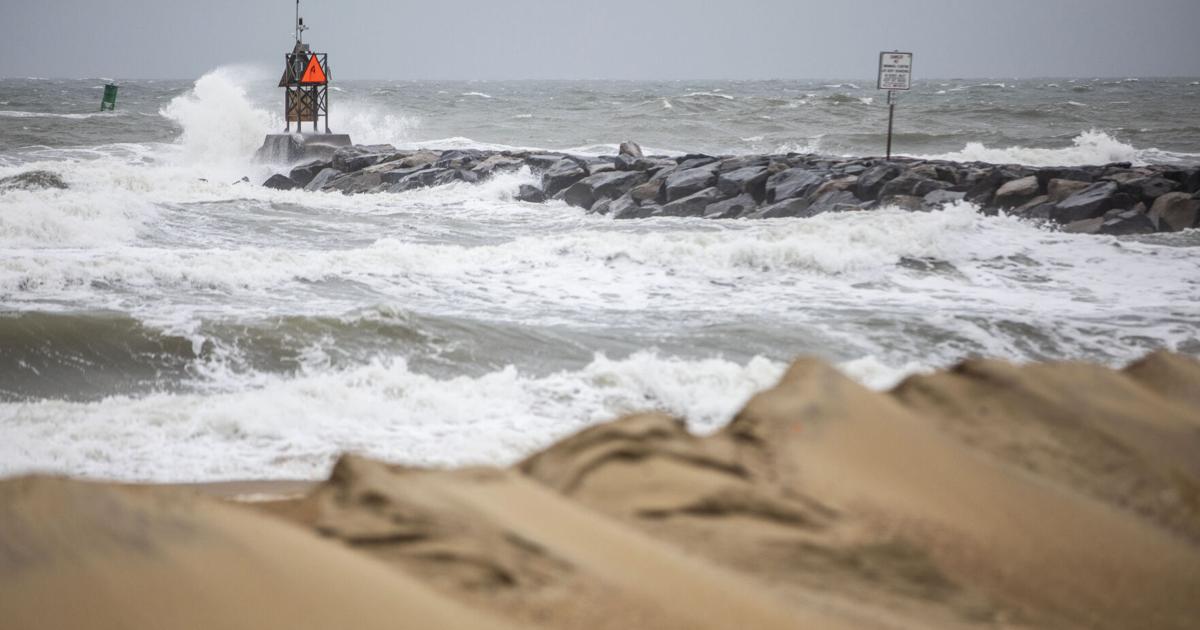
ANNAPOLIS, Md. (AP) — Tropical Storm Ophelia made landfall on the North Carolina coast early Saturday, lashing coastal areas with damaging winds and dangerous surges of water, the U.S. National Hurricane Center said.
Radar, hurricane hunter aircraft and observers on the ground found that Ophelia’s center came ashore at around 6:15 a.m. near Emerald Isle with maximum sustained winds of 70 mph (110 kph), the hurricane center said in an update. That’s roughly 25 miles (40 kilometers) northwest of Cape Lookout, the center said.
Life-threatening flooding caused by the weather system was forecast for parts of eastern North Carolina and southeastern Virginia, but the system was expected to weaken after landfall, the hurricane center said.
Ophelia is expected to turn north Saturday and then shift northeast on Sunday. The storm promised a weekend of windy conditions and heavy rain up to 7 inches (18 centimeters) in parts of North Carolina and Virginia and 2 to 4 inches (5 to 10 centimeters) in the rest of the mid-Atlantic region through Sunday.
People are also reading…
A storm surge warning, indicating danger from rising water moving inland, was in effect from Bogue Inlet, North Carolina, to Chincoteague, Virginia. Surges between 4 and 6 feet (1.2 and 1.8 meters) were forecast in some areas, the hurricane center said.
A tropical storm warning was issued from Cape Fear, North Carolina, to Fenwick Island, Delaware. A hurricane watch was in effect in North Carolina for the area north of Surf City to Ocracoke Inlet, the center reported.
The governors of North Carolina, Virginia and Maryland declared a state of emergency Friday as some schools closed early and several weekend events were canceled.
North Carolina Gov. Roy Cooper issued his state’s emergency declaration, aiming to expedite preparations and help provide a swift response.
“The storm’s path has been difficult to predict and we want to ensure that farmers, first responders and utility crews have the tools necessary to prepare for severe weather,” Cooper said.
The North Carolina Ferry System on Friday suspended service on all routes until conditions improve, officials said.
Virginia Gov. Glenn Youngkin’s executive order sought to ease response and recovery efforts.
“We want to ensure that all communities, particularly those with the greatest anticipated impact, have the resources they need to respond and recover from the effects of this storm,” Youngkin said, encouraging residents to prepare emergency kits and follow weather forecasts closely.
Maryland Gov. Wes Moore said in a statement Friday evening that the state expected an extended period of strong winds, heavy rainfall and elevated tides.
In Annapolis, Maryland’s capital, water taxi driver Scott Bierman said service would be closed Saturday.
“We don’t operate when it’s going to endanger passengers and or damage vessels,” Bierman said.
In Washington, the Nationals baseball team postponed its Saturday game until Sunday.
It is not uncommon for one or two tropical storms, or even hurricanes, to form off the East Coast each year, National Hurricane Center Director Michael Brennan said.
“We’re right at the peak of hurricane season, we can basically have storms form anywhere across much of the Atlantic basin,” Brennan said.
Scientists say climate change could result in hurricanes expanding their reach into mid-latitude regions more often, making storms like this month’s Hurricane Lee more common.
One study simulated tropical cyclone tracks from pre-industrial times, modern times and a future with higher emissions. It found that hurricanes would track closer to the coasts including around Boston, New York and Virginia and be more likely to form along the Southeast coast.
Nancy Shoemaker and her husband Bob stopped by a waterside park in downtown Annapolis to pick up sandbags. A water surge in a storm last October washed away sandbags they had in their yard.
“We’re hoping it won’t be that way this time,” Nancy Shoemaker said. “If we have a lot of wind and a lot of surge, it can look like the ocean out there, so that’s a problem.”
Brumfield reported from Silver Spring, Maryland. AP Radio reporter Jackie Quinn in Washington and AP reporter Lisa Baumann in Washington state contributed.
Photos: Billion-dollar US hurricanes and tropical storms since 1980
Hurricane Allen – 1980
A gigantic clean-up task is underway along the Texas Gulf Coast where hurricane Allen left his mark after stomping ashore on Sunday morning. Here workmen clear debris from around overturned pleasure boats at the Corpus Christi marina, Texas on August 12, 1980. (AP Photo/Ted Powers)
Hurricane Alicia – 1983

Employees of the Spin-N-Mart food store in Baytown take inventory and clean up what was left over after Hurricane Alicia stripped off the roof, Aug. 20, 1983. (AP Photo/Ron Heflin)
Hurricane Elena – 1985

Two Gulfport, Miss., men look at cars damaged when a tornado tore the roof off a school on Monday, Sept. 2, 1985 in Gulfport, Mississippi. The tornado followed in the wake of Hurricane Elena whose eye came ashore over Biloxi/Gulfport. (AP Photo/Tannen Maury)
Hurricane Hugo – 1989

FILE- In this Sept. 23, 1989 file photo, Lou de Liesseline pauses in despair after looking at the damage to her home on Folly Beach. The water surge caused by Hurricane Hugo moved the house off its foundations and back 100 feet. Hurricane Hugo might have been the first modern U.S. storm ushering in an era of live TV coverage and large scale coastal evacuations. (AP Photo/J. Scott Applewhite, File)
Hurricane Bob – 1991

New England regional FEMA chief Ed Thomas, right, talks with Frank and Mary Mahady, Sept. 25, 1991 of Mattapoisett, Mass., whose home, seen intact in far background, survived Hurricane Bob because it was built to be hurricane-resistant. Federal officials are trying to convince people rebuilding structures to follow hurricane-resistant construction plans. (AP Photo/Stephen Rose)
Hurricane Iniki – 1992

A Poipu Beach resort on the Hawaiian island of Kauai is heavily damaged following high winds and rain from Hurricane Iniki, Sept. 12, 1992. The island remains without electricity and the airports are closed. (AP Photo/Reed Saxon)
Hurricane Opal – 1995

Hurricane Opal’s devastation to housing along Panama City Beach, Fla., is shown in an Oct. 5, 1995 file photo. Insurers are watching a new hurricane season blow into Florida hoping to “dodge bullets” again. (AP Photo/Mark Foley, File)
Hurricane Erin – 1995

Emergency medical crews on ATV patrol keep a sharp eye out for residents who may need medical aide Sunday, Oct. 8, 1995, during the second day residents were allowed back on Pensacola Beach to check on personal property damaged by Hurricane Erin. This view is of Ariola Drive on the gulf-side of Pensacola Beach which was one of the hardest hit areas in Pensacola. (AP Photo/Pensacola News Journal,Bruce Graner)
Hurricane Fran – 1996

A house sits in the surf, Tuesday, Oct. 8, 1996, left in ruins after Hurricane Fran struck the tiny beach town of North Topsail in early September. Nearly every house received major damage from the storm. Preparation for a storm season is incumbent on consumers to strengthen existing properties now or construct new homes or major remodel projects as best they can to fend off storm damage this year and in succeeding years. (AP Photo/Karl DeBlaker)
Tropical Storm Frances – 1998

Shawn Anderson, left, and Victoria Dues hold onto a street sign after their car stalled out while driving through floodwaters caused by Tropical Storm Frances Friday, Sept. 11, 1998, in Houston. The storm hit land early Friday and storms dumped heavy rain on the Houston area, flooding streets and homes throughout the city and outlying areas. (AP Photo/Brett Coomer)
Hurricane Georges – 1998

FILE – In this Sept. 25, 1998 file photo, taken by Dave Martin, Key West residents Brian Goss, left, George Wallace and Michael Mooney, right, hold on to each other as they battle 90 mph winds along Houseboat Row in Key West, Fla., after the three had sought shelter behind a Key West hotel as Hurricane Georges descended on the Florida Keys. They were forced to seek other shelter when the storm conditions became too rough. Martin, a longtime Associated Press photographer based in Montgomery, Ala., died after collapsing on the Georgia Dome field at the Chick-fil-A Bowl footballg ame on Tuesday, Dec. 31, 2013. Martin was 59. (AP Photo/Dave Martin, File)
Hurricane Floyd – 1999

Residents of Portsmouth, Va., form a line to receive drinking water being distributed by the Virgina National Guard in a shopping mall parking lot Friday, Sept. 17, 1999. Distribution was to begin at noon with residents arriving as early as 9:00 a.m. to wait in line. Water still had not arrived by late afternoon. More than 100,000 people living in Portsmouth and parts of Chesapeake and Suffolk Virginia are without water in the aftermath of Hurricane Floyd. Officials say it may be as long as seven to 10days before the water system is back on line. (AP Photo/Stephan Savoia)
Tropical Storm Allison – 2001

After losing electricity and backup generators due to flooding from Tropical Storm Allison, doctors and nurses at Herman Hospital evacuate a critically ill patient down powerless escalator stairs in Houston, in a Saturday, June 9, 2001 file photo. Officials of Houston hospitals say that as a result of the 2001 disaster, their institutions are in better shape to face Hurricane Rita. (AP Photo/Michael Stravato, File)
Hurricane Andrew – 1992

The devastation left by Hurricane Andrew is clear in this Sept. 4, 1992 aerial file photo over Florida City, Fla. The storm damage to Florida City, Homestead and other small cities south of Miami was estimated at $30 billion, leaving some 180,000 people homeless. (AP Photo/Mark Lennihan, File)
Hurricane Lili – 2002

In this Oct. 3, 2002 file photo, Eusie Leboeuf of Pointe Aux Chenes, La., plays in the water in front of the Knights of Columbus Hall. A levee in this small south Louisiana town broke as Hurricane Lili came ashore, causing hundreds of homes to be flooded. It is the second time in ten years that Pointe Aux Chenes has flooded because of hurricanes. (AP Photo/Dave Martin, file)
Hurricane Isabel – 2003

Dozens of people gather in flooded downtown Annapolis, Md., Sept. 19, 2003, to see the water damage from Hurricane Isabel. Rising tides fed by high winds and rains from Isabel pushed water inland to low-lying areas around the Chesapeake Bay and Potomac River flooding homes and businesses. Shortly after Hurricane Katrina swept across the south, Cambridge Mayor Cleveland Rippons met with Dorchester County emergency officials and hosted a town hall meeting, in partto reassure residents about the city’s disaster response plan. (AP Photo/Susan Walsh)
Hurricane Charley – 2004

A Port Charlotte hardware store worker tries to salvage items from the store Saturday afternoon Aug. 14, 2004, in Port Charlotte, Fla. Hurricane Charley plowed through the area Friday afternoon leaving behind a path of destruction. (AP Photo/Chris O’Meara)
Hurricane Frances – 2004

Workers try to clear a mud slide on Interstate 40 outside of Black Mountain, N.C., Thursday, Sept. 9, 2004 after the remnants of Hurricane Frances brought heavy rains and flooding to the area. (AP Photo/Chuck Burton)
Hurricane Ivan – 2004

McKinleyville, W.Va. resident Bob Ohler walks through the debris left behind in Buffalo Creek, Tuesday, Sept. 21, 2004, in McKinleyville, after flooding from remnants of Hurricane Ivan last Friday devasted the rural Brooke County town. (AP Photo/Dale Sparks)
Hurricane Jeanne – 2004

Faith Glionna sits outside her nail salon as she waits for power to be retored in Indialantic, Fla., on Tuesday, Sept. 28, 2004. Glionna lost her home to Hurricane Frances three weeks ago and moved in with her mother, whose roof was blown off when Hurricane Jeanne struck the Florida coast last weekend. (AP Photo/Dave Martin)
Hurricane Dennis – 2005

Residents of Navarre Beach, Fla., walk past damage from Hurricane Dennis Monday, July 11, 2005. (AP Photo/John Bazemore)
Hurricane Katrina – 2005

Homes destroyed by Hurricane Katrina are shown in this aerial view, Tuesday, Aug. 30, 2005, in New Orleans. (AP Photo/David J. Phillip)
Hurricane Katrina – $180 billion in damage

Emanuel Honeycutt is followed by his son Emanuel Jr., 11, as he carries his daughter Eman, 9, through floodwaters in the French Quarter in New Orleans, Tuesday, Aug. 30, 2005, after the area was hit by Hurricane Katrina. Officials called for a mandatory evacuation of the city, but many resident remained in the city. (AP Photo/Eric Gay)
Hurricane Rita – 2005

Erroll Dominque walks through his ruined area of cane fields Nov. 7, 2005 in Erath, La. Hay rolls and other debris floated into his fields from the tidial surge caused by hurricane Rita. (AP Photo/Judi Bottoni)
Hurricane Wilma – 2005